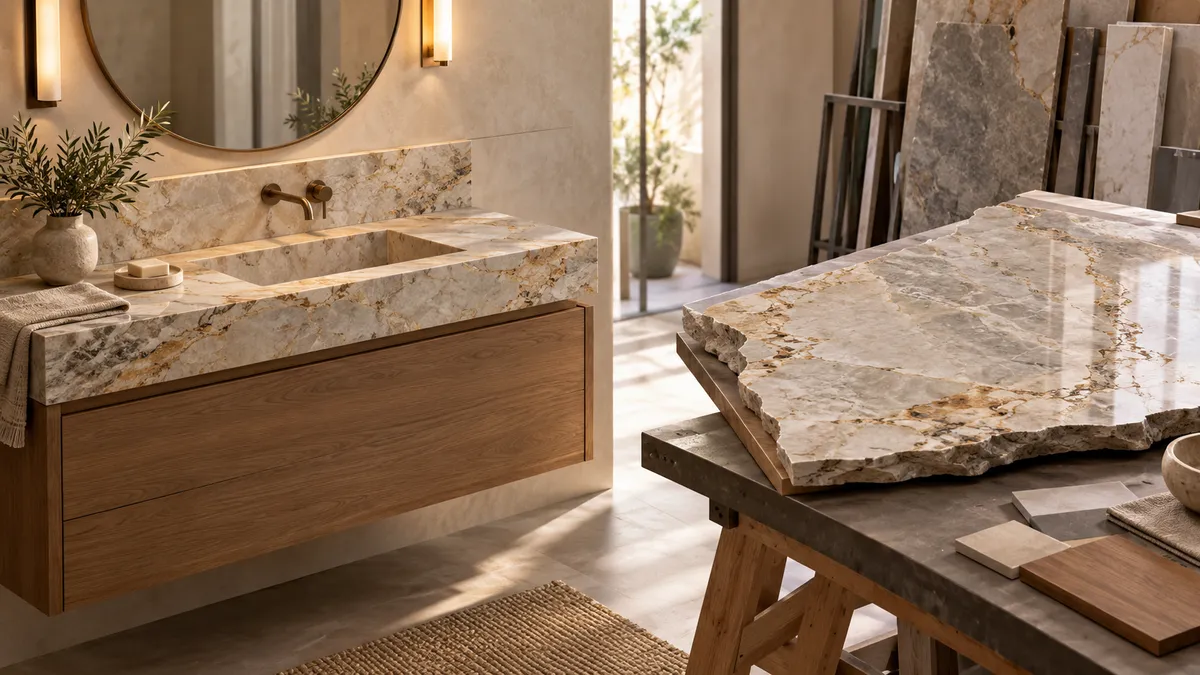
Could a Stone Remnant Work for Your Bathroom Vanity?
A bathroom vanity can sometimes be a good candidate for a stone remnant, but the decision needs more than a quick measurement of the top. A remnant is a remaining piece from a larger slab. Its usable shape, condition, pattern, and compatibility with the proposed fabrication determine whether it can serve the project.
Ask about current availability rather than assuming a particular color or size will be on hand. This article explains the questions to raise with a fabricator; it does not imply that any specific remnant is currently available from HDZ or that every remnant will produce a lower installed price.
Start with the complete piece list
List the vanity top, backsplash, side splash, and any matching pieces you want. A remnant that fits the main rectangle may not provide enough usable material for all of those details. Include exposed ends and edge requirements in the discussion.
Bring the cabinet plan and rough dimensions for initial screening, while recognizing that final fabrication requires verified field measurements. Walls, corners, and the approved overhang can change the needed dimensions. Do not treat the cabinet’s advertised width as the final size of the finished top.
Ask about usable material
The outside dimensions of an offcut do not establish how much can be used. Its shape, natural features, prior cuts, and condition can affect the layout. The fabricator should assess whether the piece is suitable for the intended application and handling.
Avoid trying to judge that suitability from a photo alone. A picture can help narrow the visual choices, but it may not show the relevant characteristics. Ask what inspection and approval process applies before the material is assigned to your project.
Check the sink opening early
The exact sink matters because the opening removes a significant part of a small vanity top. Provide the model and mounting requirements. The remaining stone around the opening, faucet holes, and edges needs to work within a suitable fabrication plan.
A change to the sink can affect whether the remnant remains usable. Settle the fixture arrangement before approving the material. If the vanity is small, even a modest difference in bowl size or faucet placement can alter the available layout.
Be flexible about the pattern
Remnant selection offers a different shopping experience from choosing among full slabs. You may have fewer options for where a vein or color change lands. The piece can still be attractive, but its existing pattern should work with your room without requiring an unrealistic layout.
View the material alongside the cabinet, tile, and wall selections. If you are trying to match an existing countertop elsewhere, discuss the limits of matching natural stone or separate product batches. A coordinated appearance may be achievable even when an exact visual match is not.
Review thickness and finish
Confirm that the available piece has a thickness and finish suitable for the proposed top. Ask which edge profiles are practical and whether any additional processing is part of the estimate. A remnant should not be selected on color alone if its other characteristics conflict with the design.
The finish also needs to fit your maintenance expectations. Obtain care guidance for the actual material, especially if it is marble or another surface whose appearance can change with common bathroom products. A smaller piece still deserves the same material review as a large kitchen installation.
Compare the full installed scope
A remnant still requires measurement, planning, fabrication, handling, and installation. Ask for a complete proposal that identifies the material and all related work. Do not assume the material’s status eliminates the labor and technical details needed for a good result.
Compare that scope with other suitable options. Include removal, disposal, support preparation, and plumbing responsibilities where relevant. The useful comparison is the finished vanity you will receive, not a headline material price separated from the work around it.
Confirm the selection and timing
Because remnant availability can change, ask how a specific piece is reserved or approved for a project. Understand any terms before proceeding, and keep the material reference with the current drawing and fixture specifications. Avoid making irreversible related decisions based on a piece that has not been confirmed.
A remnant can be worth exploring when your dimensions, design flexibility, and available material align. The strongest result comes from treating it as a custom fabrication project with a particular starting piece, rather than a shortcut around planning.
Ask HDZ Granite Renovation, LLC whether a suitable material option is available for your San Antonio vanity project. Call 210-934-8014 with dimensions, photos, and the sink information.
Image: Illustrative design concept; not an actual HDZ project.
