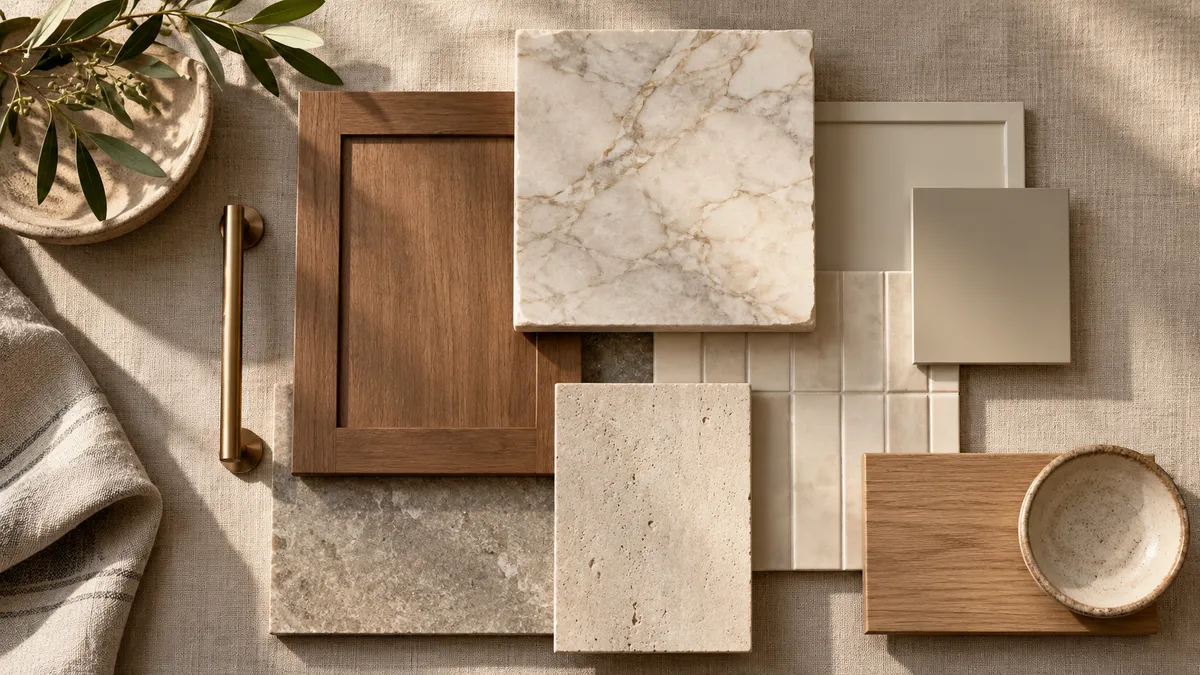
Build a Kitchen Material Palette Without the Guesswork
Kitchen selections become confusing when every material is chosen in a different setting. A countertop sample looks appealing at one showroom, a cabinet finish at another, and a backsplash online. The difficulty arrives when the pieces meet in the actual room and their colors or patterns compete.
A simple selection order can make the process calmer. Choose an anchor, keep the remaining decisions connected to it, and review physical samples together. This approach still leaves room for personal style, while reducing the chance that a late purchase forces you to reconsider the entire kitchen.
Choose the feature that matters most
Identify the part of the design you care about most. It could be a natural stone with strong movement, a particular wood cabinet, or a painted island. Make that choice the starting point rather than trying to give every surface equal visual emphasis.
If the countertop is the anchor, review enough of the selected material to understand its overall character. A small sample can leave out the movement that makes the full slab distinctive. If the cabinet finish leads the design, bring a physical sample into the stone-selection conversation.
Describe colors in relation to one another
Words such as white, gray, or beige can hide important differences. A white cabinet may look creamy beside one stone and cooler beside another. Comparing samples together reveals those relationships more clearly than choosing from color names.
Look for a combination you enjoy rather than trying to match every surface exactly. A room can feel cohesive with deliberate differences in value, texture, and finish. The key is knowing whether the contrast is intentional instead of discovering an unwanted color shift after installation.
Limit the strongest patterns
List the surfaces carrying visible movement: countertop, backsplash, flooring, and wood grain. If several are bold, decide which one should lead and which can become quieter. You do not need a rigid formula, but the room should have a readable hierarchy from the main viewing positions.
A patterned floor and a strongly veined island may work together when surrounding finishes are restrained. Another kitchen may benefit from a quieter top that leaves room for a decorative backsplash. Review the full composition rather than judging each material as an individual favorite.
Include texture and sheen
A palette is more than color. Polished stone, matte cabinetry, textured tile, and reflective metal each interact with light differently. Put finish samples together and consider whether the room has enough contrast without becoming visually busy.
Also connect the finish choice to maintenance. A surface selected for its soft texture may have a different cleaning routine from a smooth polished finish. Ask for the care requirements of the actual product so the appearance you choose comes with a routine you are comfortable keeping.
Test the samples in the kitchen
Review the group at different times of day and under the lighting you expect to use. Set samples near the surfaces they represent: cabinet finishes upright, countertop samples horizontal, and backsplash pieces against a wall. Their orientation can affect how light and shadow change the impression.
Take photos to help compare combinations, but return to the physical samples for the final decision. Phone processing and screens can alter color. If a material is especially important, avoid making the final approval from an image sent under unknown lighting conditions.
Keep the practical specifications attached
Once a palette is selected, record the exact products, finishes, thicknesses, and any approved variations. A descriptive phrase such as warm white quartz is not enough to ensure the intended selection is ordered. Keep those records with the cabinet and countertop drawings.
If an item becomes unavailable, compare the replacement with the complete approved group. A substitute can affect more than the material it replaces. Confirm any changes in size, finish, care, cost, or timing before treating it as equivalent.
Review the installed relationships
Look at the transitions that matter most: countertop to backsplash, stone to cabinet edge, flooring to island, and faucet to sink. Ask the project team how exposed ends, seams, and joints will be finished. Those small connections can determine whether the chosen palette feels complete.
You do not need every accessory chosen before construction. Focus first on the fixed materials and dimensions that shape the room. Decorative items can then support the finished kitchen without carrying the burden of correcting mismatched permanent surfaces.
For granite, marble, and quartz selection in San Antonio, contact HDZ Granite Renovation, LLC at 210-934-8014. Bring your cabinet and flooring samples to discuss a countertop that belongs in the full design.
Image: Illustrative design concept; not an actual HDZ project.
